Account-Based Marketing (ABM): The Future of High-Ticket B2B Sales
Saphiam TeamMay 14, 20267 min read
Introduction
In high-ticket B2B sales, traditional lead generation methods often fall short.
Mass outreach campaigns may generate conversations, but enterprise-level deals require precision, personalization, and strategic targeting.
That is where Account-Based Marketing (ABM) becomes a game-changer.
In 2026 and beyond, B2B organizations closing large contracts and long-term partnerships are increasingly shifting toward ABM strategies to penetrate high-value accounts and accelerate revenue growth.
If your business targets enterprise clients, this guide explains why ABM is no longer optional. It has become essential.
What Is Account-Based Marketing (ABM)?
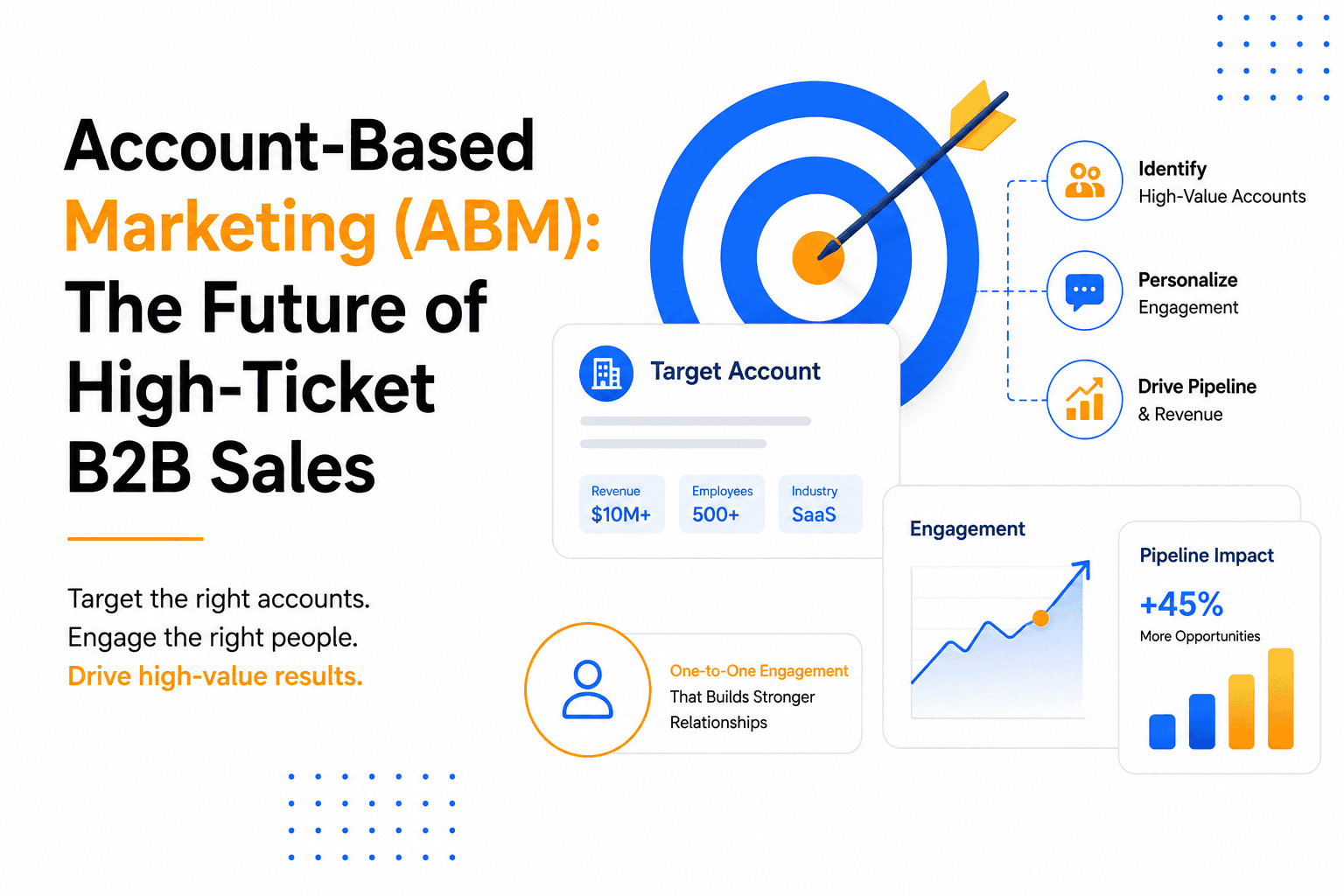
Account-Based Marketing (ABM) is a highly targeted B2B growth strategy where marketing and sales teams focus on a defined list of high-value accounts rather than broad audiences.
Instead of asking:
“How many leads can we generate?”
ABM asks:
“Which companies are most valuable to our business, and how do we strategically win them?”
ABM treats each account as a market of one.
Why ABM Works for High-Ticket B2B Sales
Enterprise-level B2B deals often involve:
- Multiple decision-makers
- Long sales cycles
- Large contract values
- Complex approval processes
Traditional lead generation may attract interest, but ABM focuses directly on decision-makers inside targeted organizations.
The result?
- Higher engagement rates
- Shorter sales cycles
- Larger deal sizes
- Better ROI
Quality over quantity wins in enterprise sales.
Key Components of a Successful ABM Strategy
1. Identify High-Value Target Accounts
The foundation of ABM begins with selecting the right accounts.
Selection criteria include:
- Industry alignment
- Revenue potential
- Strategic fit
- Market influence
- Expansion opportunities
Precision targeting ensures marketing resources are invested where the potential return is highest.
2. Deep Account Research
Effective ABM requires understanding:
- Company goals
- Organizational structure
- Pain points
- Competitor relationships
- Recent business developments
The deeper the insight, the stronger the personalization. Enterprise decision-makers expect relevance.
3. Personalized Multi-Touch Campaigns
ABM campaigns use coordinated outreach across:
- LinkedIn engagement
- Direct messaging
- Cold email campaigns
- Executive-level content sharing
- Strategic follow-ups
- Direct sales calls
Every interaction is tailored to the specific account. This level of personalization increases trust and credibility.
4. Marketing and Sales Alignment
ABM only works when marketing and sales operate as one unit.
Marketing supports:
- Account research
- Content creation
- Engagement tracking
Sales focuses on:
- Relationship building
- Objection handling
- Closing opportunities
Alignment eliminates friction and increases efficiency.
5. Performance Measurement and Optimization
Key ABM metrics include:
- Account engagement rate
- Meeting booking rate
- Pipeline value per account
- Deal velocity
- Revenue generated per target account
Unlike traditional marketing metrics, ABM focuses on account-level impact.
ABM vs Traditional B2B Lead Generation
| Traditional Lead Generation | Account-Based Marketing |
|---|---|
| Volume-focused | Account-focused |
| Broad targeting | Highly specific targeting |
| Generic messaging | Personalized messaging |
| Individual leads | Strategic accounts |
| Higher churn | Higher retention |
For high-ticket B2B services, ABM often produces significantly better ROI.
When Should a Company Implement ABM?
ABM is ideal when:
- You target enterprise-level clients
- Your average deal size is high
- Sales cycles are long
- You require multiple stakeholder approvals
- You want predictable, strategic growth
If your goal is quality partnerships over transactional deals, ABM is the right approach.
The Role of Technology in Modern ABM
In 2026, successful ABM strategies leverage:
- CRM integration
- Data analytics tools
- Intent data tracking
- Marketing automation
- LinkedIn Sales Navigator
- Performance dashboards
Technology enhances personalization at scale. However, human strategy remains the core driver.
How Saphiam Technologies Implements ABM
At Saphiam Technologies, we design structured Account-Based Marketing systems for B2B enterprises targeting high-value accounts.
Our ABM framework includes:
- Strategic account identification
- ICP-driven targeting
- Deep research and competitor analysis
- Multi-channel outreach execution
- Executive-level engagement
- Continuous performance tracking
We focus on generating qualified conversations with decision-makers, not just increasing outreach volume.
Our objective is clear: help B2B companies win strategic accounts and build long-term partnerships.
The Future of ABM in B2B Growth
As competition increases, personalization becomes the ultimate differentiator.
Future-ready B2B organizations will prioritize:
- Intent-based targeting
- AI-supported data insights
- Hyper-personalized communication
- Integrated sales and marketing operations
- Account-level ROI measurement
ABM is evolving from a tactic into a core revenue strategy.
Conclusion
Account-Based Marketing represents the future of high-ticket B2B sales.
It shifts focus from chasing leads to strategically winning valuable accounts.
For enterprises seeking sustainable growth, stronger relationships, and higher contract values, ABM provides a smarter path forward.